Coast to Coast 300km
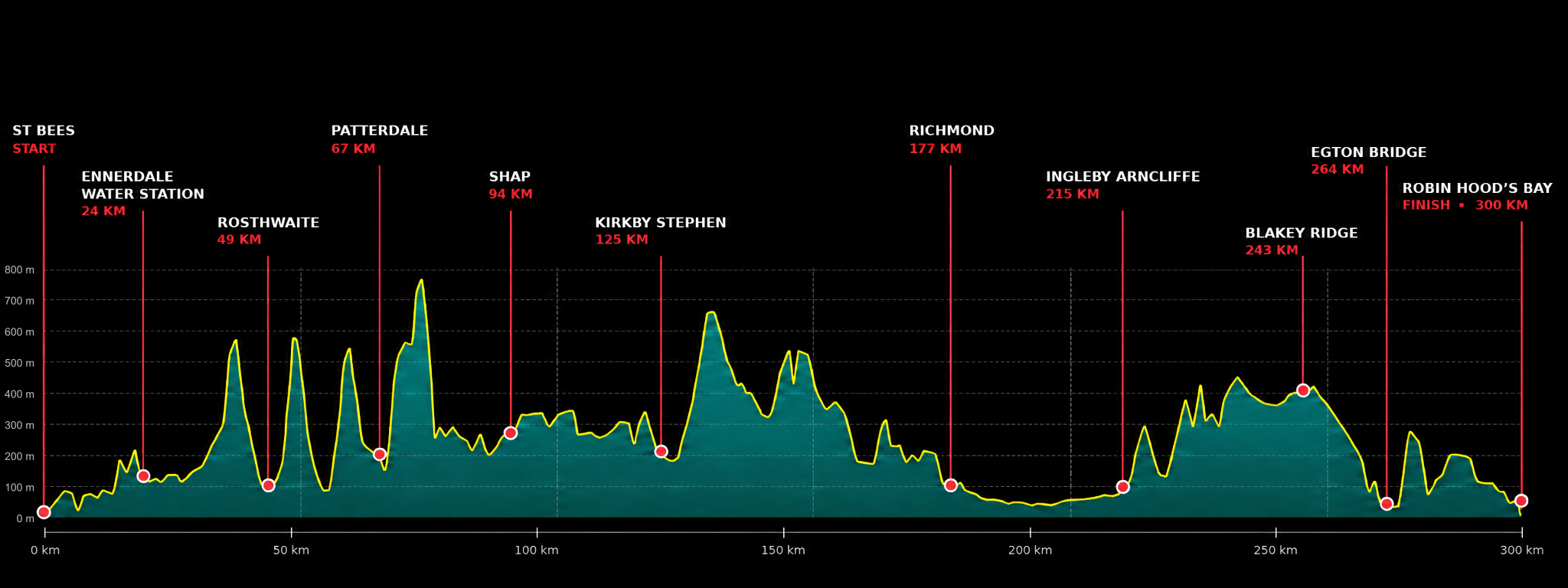
Start Venue & Registration
Seacotes Hotel St.Bees
Beach Road
St Bees
Cumbria
CA27 0ES
United Kingdom
Registration - Friday 19th March 2027
Seacotes Hotel St. Bees
13:00 - 20:00: Race registration, race-bib collection, mandatory kit checks and drop bag handover.
Participants must bring photographic ID.
Please bring your own race belt or bib pins.
Race Day - Saturday 20th March 2027 - Seacotes Hotel
04:45 - 05:30: Tracker collection.
06:00: Race starts.
Finish Line - The Bay Hotel
The Dock
Robin Hood’s Bay
Whitby
YO22 4SJ
United Kingdom
Final Cut-off Midnight - Wednesday 24 March 2027
Overall time allowance - 114 hours
After 300km across three national parks, your journey ends at the North Sea in Robin Hood’s Bay.
Some of the first finishers can be expected into Robin Hoods bay from as early as Monday morning. The entire field will have until midnight on Wednesday to reach the finish line where the Community Traverse team will be waiting to welcome each and every finisher across the line.
Course Overview
Participants will traverse Wainwright’s iconic Coast to Coast route in full from the Irish Sea at St Bees to the North Sea at Robin Hood’s Bay.
Tradition dictates that you will dip your toes in the water at St Bees, carry a stone of your choosing to travel with you and toss it into the North sea when reaching Robin Hood’s Bay.
Participants will cross three beautiful national parks: Lake District, Yorkshire Dales, and North York Moors, each offering uniquely challenging terrain and environments.
The nature of this challenge is suited towards experienced ultra runners, aspiring athletes, and long distance hikers who consider themselves physically and mentally capable of managing themselves across multiple days in remote and mountainous environments.
The route will closely follow the established Wainwright's Coast to Coast path from St Bees to Robin Hood’s Bay, our final GPX route may differ slightly where required.
While sections are well way-marked, participants must not rely solely on signage and should be competent in navigation.
Terrain includes mountain trails, moorland, forest tracks, farmland, and road crossings. Conditions underfoot will vary significantly throughout the route.
The final route GPX file and any necessary details or diversions will be provided in advance of the event.
Checkpoints, Sleeping & Rest Facilities
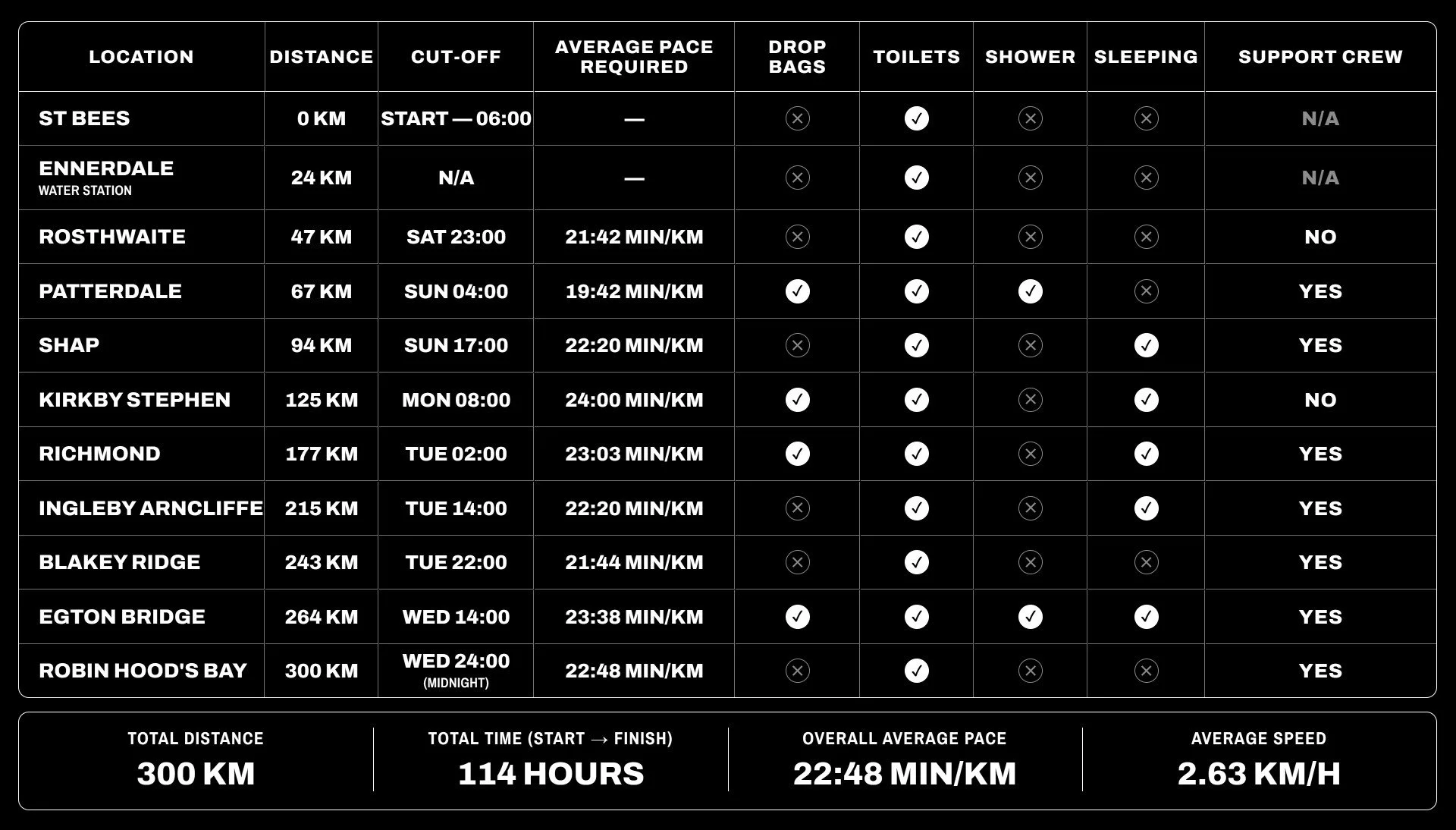
Checkpoints:
Participants can rest, reset and receive support.
Checkpoint teams will welcome participants, log their arrival and departure times, provide food and refreshments, and help with basic welfare needs.
Showers, sleeping facilities, and drop-bag access are available only at the locations shown in the checkpoint rota.
Toilet facilities and Period Products will be provided at all official community traverse checkpoints.
Food options:
Hot and/or cold food options will be available at each checkpoint location, there will be two menu options: Non-Vegan and Vegan.
Hot and cold drink options will be available at every checkpoint.
Participants with allergies or specialist dietary requirements should communicate this in advance of their race and are entitled to separate additional food allowance within their drop bags.
Participant responsibility:
Participants must remain self-sufficient between checkpoints and carry:
All mandatory kit
Sufficient food and water for the next section
Separate emergency food
Any personal medication or specialist supplies
Checkpoint support does not replace the need for proper preparation, sound judgement and the ability to manage yourself in remote terrain.
Check-in and check-out:
Every participant must be logged both entering and departing each official checkpoint.
Do not leave a checkpoint without confirming your departure with the checkpoint team.
Cut-offs:
All published checkpoint cut-offs are departure times.
Participants must have completed their stop and departed the checkpoint before the published cut-off times shown in the checkpoint rota.
Participants who are unable to leave safely before the cut-off will be withdrawn from the event.
Event changes:
Checkpoint distances are approximate and may change due to diversions or developing conditions.
Community Traverse reserves the right to alter checkpoint locations, opening times and cut-offs where required for the safe running of the event.
Participants will be informed of any material changes before or during the race.
Participants will have the option to sleep within selected checkpoints or inside a Support Crew vehicle at locations where crew access is permitted on course.
Participants may not leave the route to book or use private accommodation. This ensures that everyone remains accounted for and that the race is completed under the same conditions.
Sleeping Locations:
Sleeping facilities are available at:
Shap - 94km
Kirkby Stephen - 125km
Richmond - 177km
Ingleby Arncliffe* - 215km (No drop bag access*)
Egton Bridge - 264km
Sleeping facilities will be basic but provide warm and dry rest and refuge as a minimum.
Accommodation will include shared spaces and there may be waiting lists during busy periods.
Uninterrupted sleeping space cannot be guaranteed.
At sleeping checkpoints where drop-bag access is not available, Community Traverse will provide an air mattress and blanket.
Air mattresses and blankets must remain at the checkpoint and cannot be carried onwards.
Sleeping Equipment:
Participants must have a suitable sleeping bag left in their drop bag at all times which will be available at:
Patterdale* (Drop bag access only*)
Kirkby Stephen
Richmond
Egton Bridge
Rest Times:
Participants must agree a planned departure time with the checkpoint team before sleeping. Our volunteers will assist with wake-up requests, but participants remain responsible for waking, preparing and leaving on time.
Published checkpoint cut-offs are departure times. Sleeping or resting does not extend the cut-off or pause the race clock.
Participants who are unable to wake, prepare or continue safely may be assessed by the event medical team and withdrawn from the event.
Mandatory & Recommended Kit
Mandatory kit:
All mandatory kit must be carried by the participant at all times during the event, unless an item is specifically identified as a drop-bag item.
Mandatory kit cannot be carried by a Support Crew.
Full kit checks will take place before the race, with additional checks possible at any point during the event. Participants who cannot present complete, functional and suitable mandatory kit will not be permitted to start or continue.
Conditions can change rapidly in March. Participants must be capable of remaining self-sufficient between checkpoints and be adequately prepared for all conditions.
Clothing and weather protection:
Waterproof jacket with taped seams, an attached hood and a minimum hydrostatic head of 20,000mm.
Full-length waterproof trousers with taped seams and a minimum hydrostatic head of 20,000mm. (No half-zip trousers)
Substantial long-sleeved insulated jacket (A synthetic insulated jacket is strongly recommended)
Base Layer
Long-sleeved thermal base layer (To be carried dry and separate from the clothing worn when leaving a checkpoint)
Long-sleeved mid-layer (To be worn or carried)
Full-length thermal leggings (To be carried dry and separate from the clothing worn when leaving a checkpoint)
Warm hat
Two pairs of gloves (One warm insulating pair and one waterproof pair as a minimum)
Neck covering or Buff
At least one pair of spare socks (kept dry)
Navigation and communication:
Coat to Coast Waterproof map (not supplied) - Harveymaps.co.uk Coast to Coast
Baseplate compass suitable for use with your hardcopy map.
Fully charged GPS device or watch containing the final official GPX route.
Fully charged mobile phone.
Power bank and appropriate charging cables.
Waterproof protection for maps and electronic equipment.
GPS tracker supplied by Community Traverse.
Race-information and emergency-contact card supplied by Community Traverse.
Electronic navigation does not replace the requirement to carry and be competent using your map and compass.
Lighting:
Main headtorch, minimum 600 lumens.
Backup headtorch.
Sufficient spare batteries or charging capacity for both headtorches.
Combined headtorch battery life of at least 12 hours at a usable setting.
Rear-facing red safety light, capable of continuous use during darkness.
Emergency equipment:
Survival bag - Must be waterproof, windproof, high visibility and provide full enclosure.
Foil emergency blanket
Whistle
Personal first-aid and blister kit
- Must be kept waterproof and as a minimum include antiseptic wipes, standard fabric plasters, sterile dressing, small dose of paracetmol, medial tape or K-tape, hydrocolloid blister plasters, anti friction balm or tape.
Essential personal medication
Emergency food providing a minimum of 500 calories - Emergency food must be kept separate from normal race nutrition and used only in an emergency.
A mobile phone, watch or other navigation device does not count as a headtorch.
Food and hydration:
Bottles and/or hydration bladder with a minimum total capacity of 2 litres
Sufficient food for each section of the route (separate from emergency food)
Reusable cup
Reusable bowl and spork or cutlery suitable for hot meals
Minimum £20 cash and/or a physical payment card with sufficient funds
Two litres is the minimum carrying capacity. Participants must leave each checkpoint with sufficient food and water for the next section.
Recommended kit:
Trekking poles
Additional foot-care supplies
Electrolytes or salt tablets
Tick remover
Waterproof dry bags or pack liner
Waterproof cap
power pack
Race belt for bib number
Sunglasses
Sunscreen
Sunhat
Drop bags
Each participant must have one drop bag during the Coast to Coast 300km.
Access points:
Your drop bag will be available at:
Patterdale 67km
Kirkby Stephen 125km
Richmond 177km
Egton Bridge 260km
Robin Hood’s Bay (Finish)
Before departing each checkpoint participants must return their drop bag to the designated drop-bag area so it can be transported onwards.
Size and weight:
Your drop bag must:
Be a waterproof or robust weather resistant and secure duffel or dry bag
Have a maximum capacity of 100 litres
Weigh no more than 15kg packed
A separate additional food weight of 2kg is available for participants with specific dietary requirements or allergies. (Must be communicated in advance of their race)
Be clearly labelled with the participant’s full name, race number, and telephone number.
Sufficient food for each section of the route
Oversized, overweight or insecure bags will not be accepted.
All equipment must fit inside the bag. Shoes, sleeping bags or other items must not be tied or attached to the outside.
Your drop bag must be waterproof or robust weather resistant and capable of withstanding the elements to keep your kit dry at all times.
Mandatory drop bag items:
The following items must be included in your drop bag and can be utilised throughout the event:
Suitable warm sleeping bag for cold weather conditions in March
Spare insulated jacket
Spare waterproof jacket
Spare trail shoes
Minimum of one full spare change of clothing to include underwear, socks and base layering
Power pack and appropriate charging cables for all lighting and mobile phone
Sufficient food to carry with you for each onward section of the route
These items must be stowed in your drop bag at handover to be available at any onward drop bag location. They do not replace the mandatory equipment that must be carried with you at all times whilst on the route.
Drop bag Handover:
Drop bags must be handed in during registration - Friday 19 March, 1:00pm - 8:00pm.
Drop bags cannot be accepted after registration has closed.
Community Traverse will take care when handling bags but cannot accept responsibility for loss or damage to individual items.
Collection:
All drop bags will be transported to the finish at Robin Hood’s Bay for each participant to collect.
A Support Crew member may collect a bag where the participant has provided prior authorisation.
Participants who withdraw from the event remain responsible for collecting their bag from Robin Hood’s Bay. Bags will not be redirected to another location along the route.
Safety
Expected conditions:
The Coast to Coast 300km crosses remote mountain, moorland and rural terrain in March. Participants must be prepared for freezing temperatures, consideration for wind chill, sun, wind, rain, snow, hail, darkness, poor visibility, difficult ground, and long periods between checkpoints.
Community Traverse will provide GPS tracking, staffed checkpoints, Race HQ monitoring, medical support and an event response team.
Participants remain responsible for their own safety, navigation and decision-making throughout the event.
Race HQ and emergencies:
Race HQ contact numbers will be provided in our final participant race packs. Participants must save these numbers before the race.
Mobile phones must:
Remain switched on throughout the event
Be protected from water and cold
Have sufficient battery and charging capacity
Be checked regularly for calls or messages from Race HQ
For an immediate threat to life, serious injury or emergency, call 999 first and then contact Race HQ as soon as possible.
The GPS tracker is a safety and operational tool but does not replace emergency services, personal responsibility or the requirement to communicate directly with the event team.
Looking after each other:
If you encounter another participant experiencing difficulty, stop and assess the situation where it is safe to do so. Do not leave someone in need of help.
Contact Race HQ or inform the next checkpoint immediately. In an emergency, call 999.
No participant should be disadvantaged for providing genuine assistance. Time lost while helping another participant may be credited at the Race Director’s discretion, subject to checkpoint availability and the safe operation of the event.
Roads and public access:
Participants must:
Follow the Highway Code
Use pavements and designated crossings where available
Wear the rear red light
Remain alert to vehicles, cyclists, livestock and other trail users
Race position or cut-off pressure never takes priority over road safety.
Weather and event decisions:
Community Traverse may alter the route, advise lower-level alternatives, change checkpoints or cut-offs, pause the event or withdraw participants where conditions require it.
Decisions made by the Race Directors or Medical Director in the interests of safety are final.
Travel After the Event:
Participants must arrange their own transport from Robin Hood’s Bay after completing the event.
Due to the effects of fatigue and prolonged exertion, participants should not drive immediately after finishing or withdrawing.
A rested driver, Support Crew member, public transport or pre-arranged collection should be used for every participant.
Support, crewing and conduct
Support Crews may intercept participants at any point on the course after CP1 where it is safe and practical to do so.
Any participant seen to receive support before or at CP1 may incur a time penalty or be disqualified.
Crew access at official checkpoints is identified on the checkpoint rota.
Community Traverse may advise additional access points on route but these will not be official checkpoints and should not be relied upon by the participant.
Crew Registration:
Participants must provide the following details before the event:
Lead Support Crew name
Mobile number
Email address
Vehicle registration
Vehicles and Parking:
Only one Support Crew vehicle is permitted per participant.
Crews must:
Arrive no earlier than 30 minutes before their participant is expected
Use only designated parking areas and ensure to pay any relevant carparking fees where applicable
Keep roads, entrances and emergency access clear
Follow instructions from venue staff and event officials
Avoid blocking residents, businesses or other road users
Some locations are accessed by narrow rural roads with limited parking and mobile signal.
Crews must ensure their vehicle is suitable, maintain sufficient fuel and remain self-sufficient throughout the event.
Community Traverse cannot provide roadside or logistical assistance to support crew vehicles.
Quiet Hours:
Quiet hours apply between 10:00pm and 7:00am, particularly in residential areas and at venues where participants are sleeping.
Respecting local communities is paramount.
During these hours, crews must:
Keep voices, doors and vehicle noise to an absolute minimum
Switch off engines when parked
Avoid unnecessary lighting
Follow any venue-specific instructions
Leave immediately if asked by an event official
Permitted Support:
Registered support crews may provide their participant with food, drink, clothing, foot-care assistance, moral support and personal supplies.
Crews must not:
Carry mandatory kit between locations
Accompany or pace a participant on the route
Transport a participant forwards along the course
Take checkpoint food or refreshments for themselves
Obstruct volunteers, medical staff or other participants
Checkpoint food and drink are for registered participants. Crews must carry their own supplies, leave no trace and take all rubbish with you.
Conduct:
Event Officials may ask a support crew to leave a location where their behaviour, parking or assistance breaches event rules or causes a nuisance.
Any breach by a support crew may result in a warning, time penalty, withdrawal or disqualification being applied to their participant.
Participants with a support crew will still receive the same Community Traverse checkpoint support as everyone else.